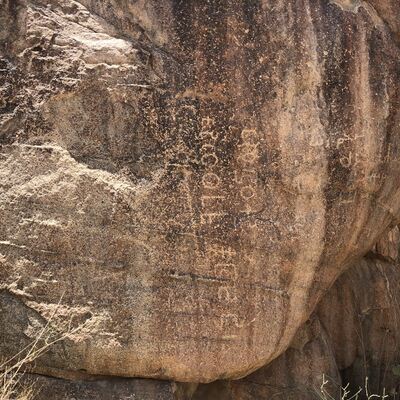
Rīʿ al-Zallālah, Makkah Province, Saudi Arabia
Rīʿ al-Zallālah is an important pass connecting Tāʾif to Mecca on the traditional route through al-Sayl al-Kabīr. This route was used at the time of Mohammd and, indeed, earlier, to which the Thamudic inscriptions carved on its rocks testify. The pass is mentioned in Islamic sources as an important nexus, referred to as ʿAqabat al-Zallālah by al-Aṣfahānī (1968: 28). 𝐇𝐢𝐬𝐭𝐨𝐫𝐲 𝐨𝐟 𝐯𝐢𝐬𝐢𝐭𝐚𝐭𝐢𝐨𝐧: The site was first visited by western explorers in 1845, where James Hamilton described a large panel of rock art on a boulder on the side of the pass. Doughty was the first to copy the scene, which included a carving of a large, seated man with a staff along with the three columns of Thamudic texts. He described the presence of “four or five more Kufic inscriptions” in the passage, but these were not included in his publication (Doughty 1921: 528–529). His drawing of the panel is rather inaccurate when compared to what appears on the rock. And, more importantly, he neglected an early Arabic inscription to the right of the Thamudic columns. The first scholar to attempt a reading of the Thamudic texts was A. van den Braden (1950), although his interpretations were far from reliable. The Philby-Ryckmans-Lippens expedition to Arabia in 1951–1952 produced the first photograph of the panel, which recorded an archaic Arabic inscription to the right of the Thamudic columns. This text was studied by A. Grohmann (1962), and he supplied a reading and tentatively dated the inscription to the first or second century AH. In 2021, the American team consisting of Ahmad Al-Jallad and Hythem Sidky visited the site and took the first modern photographs of the boulder. Their study was able to supply the first reliable reading of the Thamudic inscriptions as well as identify the Arabic text read by Grohmann as a Paleo-Arabic inscription, a precious witness to the development of the Arabic script in the region (Al-Jallad and Sidky 2022). In 2025, Al-Jallad returned to th site and recorded major damage done to the area as a result of digging and construction activity (perhaps for road expansion or internet cables). Luckily, the boulder bearing the inscriptions narrowly survived destruction (see photos).
Cite this Site
- [RZTham] Al-Jallad, A., & Sidky, H. A Paleo-Arabic inscription on a route north of Ṭāʾif. Arabian Archaeology and Epigraphy 33, 2022: 202–215.
- Doughty, C.M. Travels in Arabia Deserta. With a new Preface by the Author, an Introduction by T.E. Lawrence and all its Original Maps, Plans and Cuts. Thin-paper edition in one volume complete and unabridged, London, Cape, 1930. New York: Boni and Liveright, 1923.
- Grohmann, A. I. Arabische Chronologie. II. Arabische Papyruskunde. Mit Beiträgen von J. Mayr und W.C. Till. (Handbuch der Orientalistik. I.Abteilung. Der Nahe und der Mittlere Osten, Ergänzungsband II. 1.Halbband). Leiden: Brill, 1966.
- Hamilton, J. Sinai, the Hedjaz, and Soudan: Wanderings around the Birth-Place of the Prophet, and across the Aethiopian Desert, from Sawakin to Chartum. Reprinted with an introduction by Robin Bidwell, Reading: Garnet, 1993. London: Bentley, 1857.
- van den Branden, A. Les inscriptions thamoudéennes. (Bibliothèque du Muséon, 25). Louvain: Publications Universitaires de Louvain/Bibliothèque du Muséon, 1950.
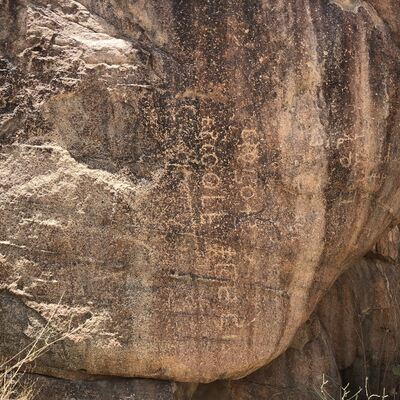
RZTham 2